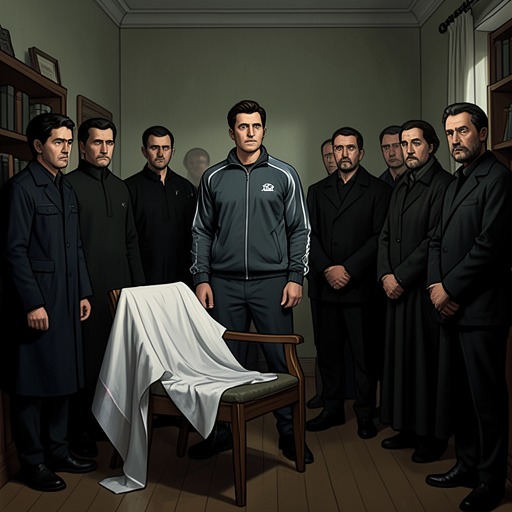
Death and funeral of Queen Elizabeth II
Player Manager: A Sports Progression FantasyQueen Elizabeth II’s death and funeral function in Max Best’s story less as a ceremonial background event than as an accidental turning point. The national interruption to English football gives Max his first opening into the football industry: he later recalls that he got his break because the Queen died. The event therefore joins public mourning to private opportunity, converting a moment of collective suspension into the beginning of his precarious professional identity.
Public Disruption and Private Opportunity
The death of Queen Elizabeth II suspended English football and created the unusual circumstances through which Max could act. He treats the connection with uncomfortable candour: when recounting his career to another football figure, he lists getting his break because the Queen died among his professional war stories. The phrasing makes the opportunity sound both consequential and morally awkward. Max did not engineer the national event, but he benefited from the vacancy and confusion it produced, and the memory remains attached to the sense that his career began through an accident rather than through recognised expertise.
The funeral continued to occupy his practical and emotional world after the immediate disruption had passed. Max kept “Queen’s funeral notes” on the kitchen table beside the toaster, where Jackie Reaper could have read them while retrieving Max’s baseball cap and sunglasses. The notes become a small but revealing physical trace of the event: public history has entered domestic space, and Max’s private preparation is vulnerable to discovery even in an ordinary moment of assistance.
The Event as an Entry into Football
The opening created by the royal death did not make Max an established professional. It merely allowed him to begin crossing a closed boundary. After deciding that he was an agent, he had to learn the profession from the outside, including how scouts and agents obtained access to matches. Jackie Reaper was astonished that Max had been paying full admission to games and explained that agents and scouts did not pay to enter: they could call a club, identify a player they wanted to watch, and collect tickets at the turnstile. Max’s initial ignorance shows that the opportunity created by the national interruption had not supplied the cultural knowledge, contacts, or privileges of the football world.
His first attempts to convert that opening into practical work were correspondingly improvised. He contacted Bill Brown while trying to obtain tickets for the Wrexham game, introducing himself as a Manchester-based scout and agent. The call marks a movement from opportunistic access toward a claimed professional role, but the casual disinterest on the other end of the line also shows how little authority the title carried before Max had built relationships and experience.
From Pretence to Procedure
Max gradually learns that entering football requires more than enthusiasm and self-presentation. He undergoes a football medical, the testing clubs conduct before signing players, and recognises the procedure as one of the formal rituals separating professional players from spectators. He also tries to perform expertise by filling in a scouting report from Southport, only to be questioned by Jackie Reaper about the document and its categories, including fitness, resources, and score. The incident turns the aftermath of the royal event into a longer apprenticeship: the first opportunity gives Max access, but football’s paperwork and vocabulary expose his amateur status.
The same process appears in his dealings with players and families. At the Yalley household, Max presents himself as a football agent, offers to represent James Yalley and Kisi Yalley, proposes the industry-standard ten-percent rate, and promises no upfront or hidden fees. He describes his long-term role as balancing financial and footballing needs and his short-term role as securing the training required to develop their potential. The parents’ astonishment and Mrs. Yalley’s question about whether the children truly have talent underline the distance between Max’s confident pitch and the family’s uncertainty about the profession.
Consequences for Max’s Professional Identity
The royal death remains the origin story Max tells about his career, but the later consequences are governed by qualification, trust, and responsibility rather than by luck. He discovers that he does not yet possess a Football Association Number or licence, a failure that threatens Ziggy Graves’s proposed signing. When the club requires the number immediately, Max admits that the licence will probably not arrive until January and tells Ziggy that he must sign without him. His poverty and lack of credentials might otherwise have blocked the younger player’s ambition; instead, Max refuses to stand in Ziggy’s way, even though the decision diminishes his own formal role.
That setback clarifies the difference between calling oneself an agent and being recognised as one. Max wants to work in football badly enough that even bland copy for a club website would be preferable to being ignored by “real football people,” yet he also insists that he needs a role in which he can make decisions and be taken seriously. His entry, begun through the extraordinary circumstance of the Queen’s death, thus develops into a struggle for institutional legitimacy.
Later Meaning and Narrative Significance
The event’s influence persists through a chain of relationships and attempted conversions of access into authority. Max tells his stories of gatecrashing an FC United of Manchester training session, helping defeat Manchester City Under-16s, and then asking Manchester City for a trial for Kisi Yalley. He presents these episodes as evidence of persistence, but they also reveal a recurring pattern: he enters through audacity, then has to submit himself to the judgments of clubs, coaches, families, and regulations.
Mike Dean later offers to help him find a place within a club, proposing that Max begin with expanded scouting duties and perhaps youth recruitment before any larger role could be created. The offer is explicitly incremental, a trial period built around the overlap between Max’s abilities and the club’s needs. Max resists being confined to a position where he has no meaningful authority, while Mike insists that youth coaches, rather than a single senior figure, should decide which players are cut. The contrast completes the event’s arc. Queen Elizabeth II’s death opens the door, but it cannot confer competence, licence, trust, or decision-making power. Those must be negotiated afterward, one humiliating test and one relationship at a time.